Django is a free Python framework behind Instagram, part of Pinterest, and thousands of smaller websites, dashboards, and online stores. If a developer has proposed “an app built with Django” or you have come across the name while looking for a technology for your own project, this guide will explain in plain English what Django is, what it is good for, and when you should choose something else.
Table of contents
- What is Django?
- Where did it come from and who uses it?
- How does Django work? Model, view, template
- What is Django suitable for?
- When is Django not a good choice?
- Django or WordPress, Laravel, Next.js?
- What do you need to run a Django application?
- How much does Django hosting cost?
- FAQ: frequently asked questions about Django
What is Django?
Django is a web framework, that is, a ready-made set of tools and conventions for building web applications in Python. Instead of writing user authentication, form handling, database connections and protection against common attacks from scratch, the developer gets all of this out of the box and can focus on what makes their project unique.
Its creators describe it with the motto “The web framework for perfectionists with deadlines.” This captures the character of Django well: it is comprehensive and rather opinionated about how a project should be structured, which allows the team to quickly get a working version up and running while keeping code from different developers consistent.
A few key facts:
- License: open source (BSD), free of charge, including for commercial projects.
- Language: Python, one of the most popular programming languages in the world.
- Type: a “batteries included” framework (from English batteries included), with a large number of built-in modules.
- Versions: the 5.x and 6.x branches are currently under development, a new release appears roughly every eight months, and selected versions have multi-year support (LTS).
An important distinction: Django is not a ready-made website or a point-and-click system, like WordPress. It is a foundation on which a developer builds an application. A business owner usually does not write code in Django, but commissions the project and then uses the finished admin panel.
Where did it come from and who uses it?
Django was created in 2003 at the Lawrence Journal-World newspaper in Kansas. The journalists needed websites that could publish at newsroom speed, so the developers built a tool that made it possible to launch a new site section within a few days. In 2005, the code was released publicly, and since 2008 the project has been overseen by the independent Django Software Foundation.
Django has been used by, among others:
- Instagram (one of the largest Django installations in the world),
- Pinterest in its early days,
- Mozilla (some of its websites and add-ons for Firefox),
- Disqus, Eventbrite, government organizations' and universities' websites.
In Poland, Django is popular among software houses, startups and companies building internal systems. The Saplo platform, which you're reading this article on, is also written in Django.
How does Django work? Model, view, template
Django divides an application into three layers. Its creators call this setup MTV (Model, Template, View):
| Layer | What it is responsible for | Online store example |
|---|---|---|
| Model | description of the data and its storage in the database | a product has a name, price, and stock level |
| View | logic: what to do with the request | retrieve products from the “shoes” category |
| Template | page appearance in HTML | a list of products with photos and prices |
When someone enters an address in their browser, Django checks the URL configuration file (urls.py) to determine which view should handle the request. The view retrieves data through the model, passes it to the template, and returns the finished page. Developers do not write SQL queries by hand because Django has a built-in ORM, which acts as a translator between Python code and the database.
Django also includes modules that have to be installed separately in other technologies:
- an admin panel generated automatically from the models, ready for entering data from day one,
- login, registration, permissions, and user groups,
- forms with data validation,
- database migrations, meaning safe changes to the table structure as the project evolves,
- protection against common attacks: CSRF, XSS, SQL injection, clickjacking,
- support for multiple languages and time zones,
- caching, email sending, sitemaps, and RSS feeds.
The admin panel is often the strongest argument for companies. Clients get a convenient place to manage data even before the application frontend is built.
What is Django good for?
Django works well wherever data, users, and business logic matter, not just the appearance of a website. Typical uses include:
- Internal business systems: CRM, reservations, order tracking, document workflows, and employee dashboards.
- Platforms with user accounts: subscription portals, online courses, classifieds websites, and marketplaces.
- Backend APIs for mobile apps and front ends built with React or Vue, most commonly with Django REST Framework.
- Content-heavy websites: news portals, directories, and knowledge bases (Wagtail CMS, among others, runs on Django).
- Projects involving data analytics and AI: Python is the primary machine learning language, so the model, analytical scripts, and web application can all live in one ecosystem.
- Stores with unconventional logic: product configurators, B2B wholesale operations with custom price lists (e.g. Saleor, Django Oscar).
The common denominator is a project where an off-the-shelf CMS starts getting in the way because you have to bend it with plugins to do things it was never designed for.
When is Django not a good choice?
To be honest, not every project needs a framework. Django will be overkill when:
- you need a simple one-page website or blog that someone without technical knowledge will edit. WordPress wins here with its quick setup and wide range of ready-made themes,
- you don't have a developer and don't plan to hire one. Every change to a Django application requires working with code,
- you're building a simple online store with a standard product range. WooCommerce or a ready-made ecommerce platform will be faster and cheaper to get running,
- the project is primarily an interactive front end (animations, an app running in the browser), and the backend is minimal. Next.js may be a more natural fit.
A good rule of thumb: if the project description sounds like a “website”, start with a CMS. If it sounds like a “system” or an “app”, Django is a strong candidate.
Django or WordPress, Laravel, Next.js?
| Criterion | Django | WordPress | Laravel | Next.js |
|---|---|---|---|---|
| Language | Python | PHP | PHP | JavaScript / TypeScript |
| Type | framework | ready-made CMS | framework | framework (frontend + server) |
| Admin panel | built in, generated from models | built in | plugins (e.g. Filament) | none, you have to build it |
| No developer needed | no | yes | no | no |
| Best for | systems, APIs, data | websites and blogs | PHP systems | fast frontends, SaaS |
| Hosting | server with Python | standard PHP hosting | PHP hosting | Node.js or Vercel |
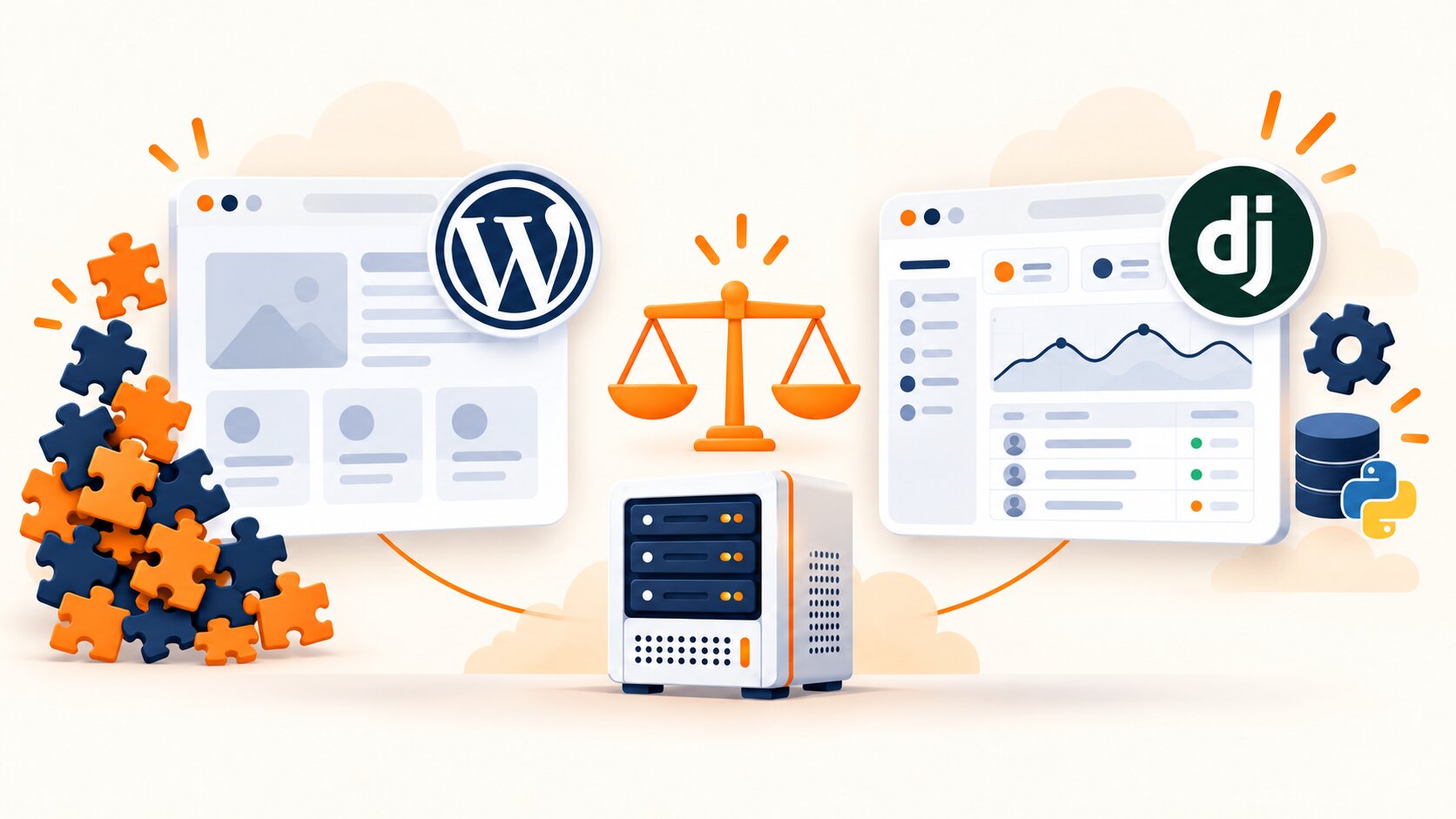
We wrote more about the differences between a ready-made CMS and a framework in the comparison WordPress or Next.js for a company website and the article What is Next.js. The choice between Django and Laravel usually comes down to the language your team works in, as both frameworks offer comparable capabilities.
What do you need to run a Django application?
Many people are surprised by this: you can't deploy a Django application to standard shared hosting that only supports PHP. You need:
- Python in the appropriate version (Django 5.x works with Python 3.10 and newer),
- an application server, most commonly gunicorn, which runs Python code,
- a web server, such as nginx, which receives traffic from the internet and passes it to gunicorn while also serving static files,
- a database: SQLite to get started, PostgreSQL for higher traffic,
- a supervisor process that will restart the application after a failure or server restart,
- an SSL certificate and a connected domain.
On your own VPS, you have to install and configure all of this yourself, then keep the system updated. For a developer, this takes a few hours of work. For a business owner, it's usually a barrier that's difficult to overcome.
On Saplo, this stage is fully automated. When creating a Django application in the dashboard, you choose the Python version (3.11 or 3.12), and the installer automatically creates a virtual environment, installs Django 5.x, starts gunicorn under the supervision of the supervisor process on port 8000, configures nginx in front of the application, adds the domain to ALLOWED_HOSTS, and provisions a free SSL certificate. The starter uses SQLite, and when the application uses a separate database, its address is passed to the process in the DATABASE_URL variable.
Your own code is deployed from a GitHub repository: once the repository is connected, every git push to the production branch triggers a build and deployment of the new version, usually within 1 to 3 minutes. We described the process step by step in our guide to How to deploy Django on Saplo with your own Python application. If your project combines a Django backend with a React frontend, there's also a ready-made option for Django + React on one domain, with no CORS configuration required.
Do you already have a working Django application with another provider? Migration to Saplo is free with every plan. All you need to do is submit your project through the migration form.
How much does Django hosting cost?
The framework itself is free, and you only pay for the server. You will come across three approaches:
- Unmanaged VPS: the cheapest subscription option, but configuration and security are up to you.
- PaaS platforms (e.g. Heroku, Render): convenient deployments from Git, billed monthly in dollars, with costs growing as the number of services and your database expand.
- Hosting with a ready-made Python environment, such as Saplo: deployments from Git and one fixed annual fee in dollars.
A Django application on Saplo needs at least 256 MB of RAM and 2 GB of disk space, so a small project will already fit on the lowest plan. Saplo plans come with the same price for the first year and renewal:
| Plan | Price / year | RAM | Disk | SSH | Backups |
|---|---|---|---|---|---|
| Box S | $29 | 1 GB | 15 GB | no (panel, SFTP) | none |
| Box M | $69 | 2 GB | 30 GB | yes | none |
| Box L | $149 | 6 GB | 60 GB | yes | 7 days |
| Box XL | $329 | 12 GB | 150 GB | yes | 14 days |
In practice: Box S is enough for a prototype or a small internal dashboard. A developer who wants to access the server via SSH (e.g. to run manage.py shell or review the logs) needs at least Box M. A production application with a PostgreSQL database, background jobs and real traffic will feel comfortable on Box L, which also includes daily backups retained for 7 days. See the full comparison in Saplo pricing.
Summary
Django is a mature, free Python framework that gives developers an admin panel, authentication, a database, and security features from day one. It works best for enterprise systems, platforms with user accounts, APIs, and data-driven projects. For a simple landing page or blog, WordPress is a better choice. If you already have a project in Django or are about to order one, you can launch it on Saplo with deployments from Git and no manual server configuration.
FAQ: common questions about Django
Is Django free? Yes. Django is open source under the BSD license and can be used free of charge, including in commercial projects. The costs are the developer's time and the server on which the application runs.
Is Django suitable for beginner developers? Yes, provided you know the basics of Python. The official documentation has an extensive tutorial, and the Polish Django Girls community has been running free workshops for people starting from scratch for years.
Is Django fast and capable of handling high traffic? Yes. Performance depends mainly on the application architecture, database, and caching, rather than the framework itself. The best proof is Instagram, which handles hundreds of millions of users on Django.
Can I run Django on regular hosting? Not on typical shared hosting that supports only PHP. You need a server with Python, an application server (e.g. gunicorn), and nginx. On Saplo, the entire environment is configured automatically when you create an application. You can find more details on the Django hosting page.
How much RAM does a Django application need? A small application can run with just 256 MB of RAM. A production project with a PostgreSQL database, background jobs (e.g. Celery), and higher traffic is worth planning for 2 to 6 GB of RAM.
- #Django
- #Framework
- #Hosting Django
- #Python